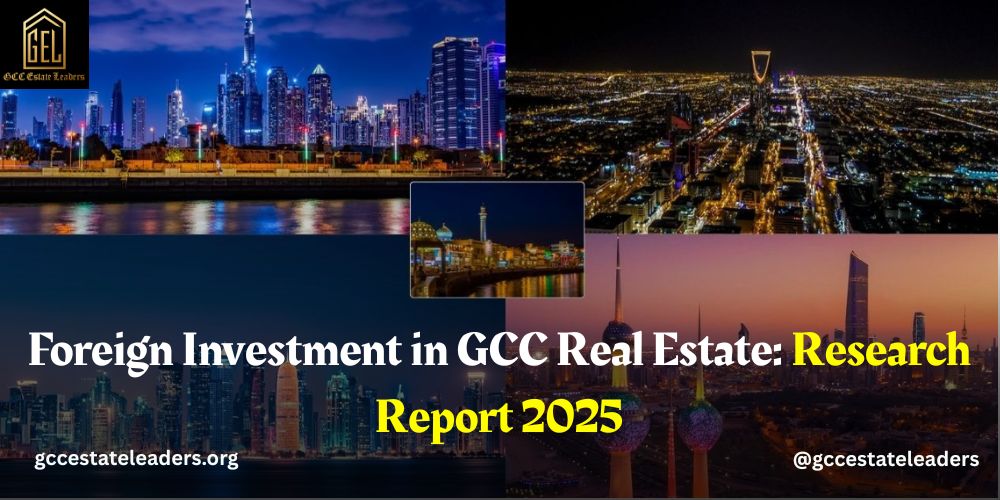
Foreign capital continues to play a defining role in the evolution of GCC real estate markets. As global investors rebalance portfolios amid inflation, geopolitical uncertainty, and slowing growth in traditional markets, the Gulf region stands out for its policy stability, infrastructure-led growth, and increasingly open investment frameworks.
In 2025, foreign investment in GCC real estate is no longer opportunistic – it is strategic. This research report examines where foreign capital is flowing, what is driving demand, and how investors should assess opportunities and risks across the region.
GCC Real Estate in 2025: A Market Backed by Policy and Capital
The GCC property market has entered 2025 with strong momentum. Transaction volumes across major cities remain elevated, supported by population growth, rising business activity, and sustained government spending on infrastructure and housing.
Unlike previous cycles driven primarily by speculation, the current phase reflects end-user demand, institutional participation, and long-term residency commitments. Foreign investors are increasingly viewing GCC real estate as a core allocation rather than a short-term trade.
This shift is particularly visible in the UAE and Saudi Arabia, where ownership reforms and residency-linked incentives have reshaped buyer behaviour.
A deeper comparison between the region’s two largest markets is explored in
UAE vs Saudi Arabia: GCC Property Outlook Comparison for Investors
Why Foreign Investors Are Increasing Exposure to GCC Property
Regulatory Clarity and Ownership Access
One of the strongest drivers of foreign investment is regulatory transparency. The UAE has spent more than a decade refining freehold frameworks, escrow regulations, and investor protections. Saudi Arabia is now following a similar path as part of Vision 2030, signalling long-term intent rather than temporary reform.
For global investors, clarity matters more than incentives. Predictable rules, enforceable contracts, and improving governance standards have made GCC property markets easier to underwrite and scale.
Residency, Mobility, and Lifestyle Appeal
Residency-linked ownership programs continue to influence demand. Long-term visas tied to property investment have encouraged expatriates and international buyers to shift from renting to owning.
Beyond visas, lifestyle factors – safety, infrastructure, global connectivity, and quality of living, increasingly shape foreign investment decisions, particularly in residential and mixed-use assets.
Attractive Yield Profiles
Compared to many global gateway cities, GCC markets still offer competitive rental yields. While yields have compressed in prime locations, income returns remain attractive when adjusted for tax efficiency and currency stability.
A broader yield and pricing outlook is covered in
GCC Property Outlook: Will Prices Continue Rising in 2025–2026?
Market Breakdown: Where Foreign Capital Is Concentrated
United Arab Emirates
The UAE remains the most mature and internationally accessible real estate market in the GCC. Dubai, in particular, benefits from liquidity, depth of supply, and a diverse buyer base spanning Europe, Asia, Africa, and the CIS.
Foreign investment here is spread across:
-
Prime and luxury residential
-
Branded residences
-
Income-generating mid-market apartments
-
Select commercial and hospitality assets
Dubai’s ability to absorb new supply while maintaining demand has reinforced its role as the region’s investment benchmark.
Saudi Arabia
Saudi Arabia is transitioning rapidly from a domestic housing market into a regional investment destination. Housing demand is driven by demographics, urbanisation, and job creation linked to Vision 2030.
While foreign ownership remains more structured than in the UAE, investor interest is rising steadily, particularly in Riyadh and major economic zones. Early foreign investors are positioning ahead of broader market liberalisation expected over the coming years.
Emerging GCC Markets
Qatar, Oman, Bahrain, and Kuwait continue to attract targeted foreign investment, particularly in master-planned developments and freehold zones. These markets appeal to investors seeking diversification, lower entry prices, and long-term upside rather than immediate liquidity.
For a balanced view of regional opportunities and constraints, see
GCC Property Outlook for Foreign Investors: Opportunities & Risks
Asset Classes Attracting Foreign Investment
Residential and Luxury Real Estate
Residential property remains the primary entry point for foreign investors. Within this segment, luxury real estate has shown exceptional resilience, driven by limited supply, global wealth migration, and demand for lifestyle-led assets.
Branded residences, waterfront developments, and ultra-prime villas continue to command strong interest, particularly in Dubai and select GCC capitals.
A focused analysis of this segment is available in
Luxury Real Estate Outlook GCC: Demand & Sustainability
Commercial and Mixed-Use Assets
Foreign institutional capital is increasingly exploring office, logistics, and mixed-use developments. As regional economies diversify and corporate activity expands, demand for Grade A commercial space is improving, especially in Saudi Arabia and the UAE.
Long-term leases, government-backed tenants, and strategic locations are key criteria for foreign buyers in this segment.
Risks Foreign Investors Must Consider
Despite strong fundamentals, GCC real estate is not without risk. Investors should closely monitor:
-
Pricing sustainability in high-demand submarkets
-
Supply pipelines, particularly in residential developments
-
Regulatory changes, including zoning, taxation, and ownership rules
-
Market maturity differences between GCC countries
Successful foreign investment in the region increasingly depends on market selection, asset quality, and long-term strategy, rather than broad exposure.
Outlook: Foreign Investment in GCC Real Estate Beyond 2025
The outlook for foreign investment in GCC real estate remains positive. Structural reforms, capital-friendly policies, and demographic growth continue to support demand. More importantly, the region is moving toward institutional-grade real estate markets rather than speculative cycles.
For global investors seeking diversification, income, and long-term capital appreciation, the GCC, led by the UAE and Saudi Arabia, is likely to remain a priority destination well beyond 2025.
As the market evolves, disciplined analysis and local insight will be essential to capturing value in one of the world’s most dynamic real estate regions.
For continued insight into GCC market comparisons, policy shifts, and investor behavior, explore expert analysis on GCC Estate Leaders.
For more such articles, please follow us on LinkedIn and Instagram & Facebook