Dubai’s property market has stepped into 2026 with strong momentum. Transactions remain high. Investor sentiment is steady. Capital continues to flow in from Europe, Asia, Africa, and across the GCC.
According to the Dubai Land Department (DLD), total real estate transactions in 2025 exceeded AED 500 billion. That figure alone tells a clear story. Dubai is not slowing down. It is evolving.
For international investors, the key question is simple:
Should you invest in off-plan property, or buy a ready unit for better returns in 2026?
There is no one-size-fits-all answer. The right choice depends on how much capital you want to deploy, how long you plan to hold the asset, and how much risk you are comfortable taking.
In my view, the decision should be strategic, not emotional. Off-plan and ready properties serve different purposes. Both can perform well. But they deliver returns in different ways.
Let us break this down clearly and practically, from an investor’s standpoint.
Understanding Off-Plan Properties in Dubai
Off-plan properties are homes or apartments sold by developers before construction is fully completed. In many cases, investors buy at the launch stage, sometimes when the project is still on paper.
The appeal is clear.
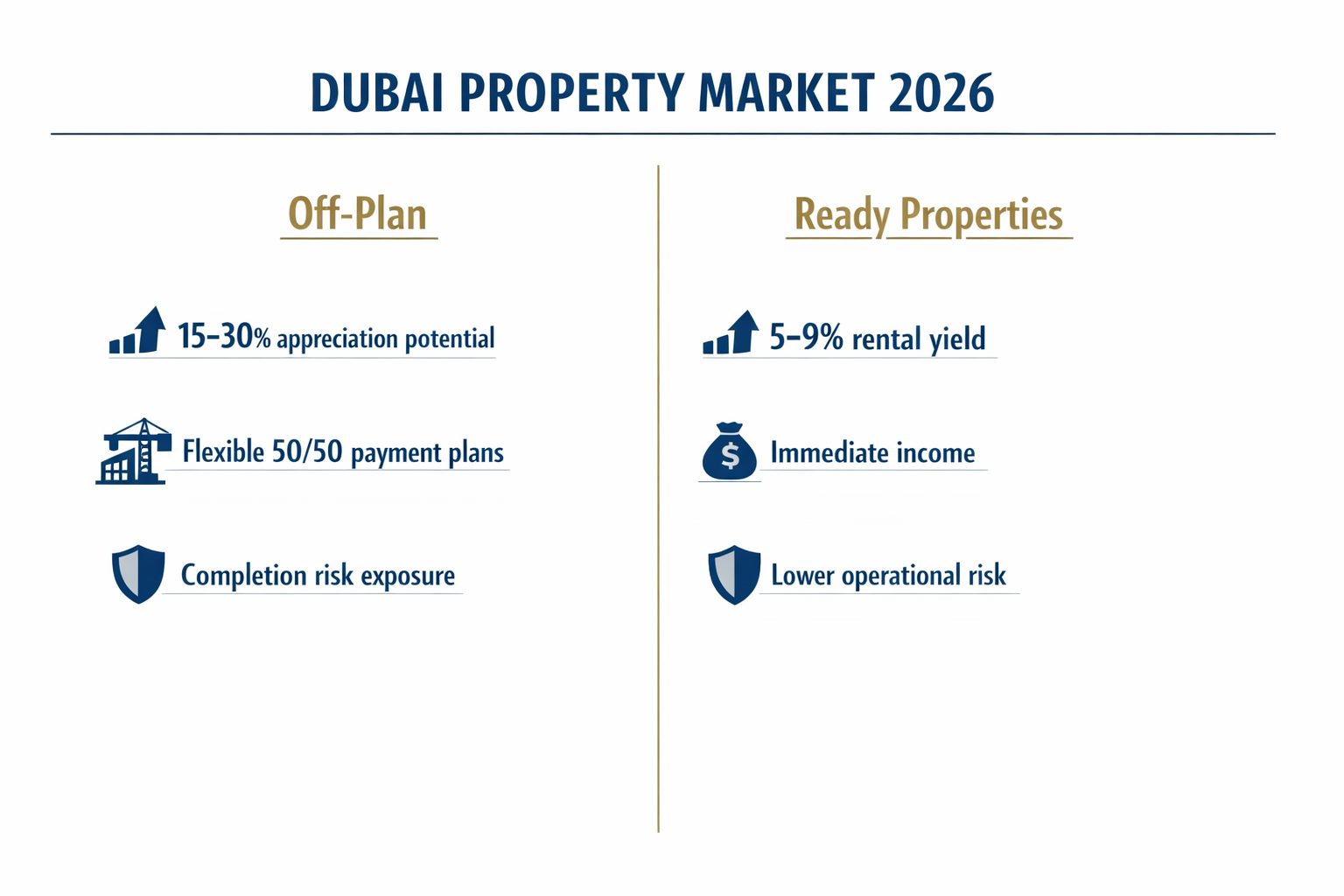
Buyers usually enter at a lower price compared to completed units in the same area. Developers also offer structured payment plans. These often follow models such as 50/50 or 60/40, and some include post-handover options. This reduces the need to deploy the full capital upfront.
Another key advantage is appreciation. If the project is well located and delivered on time, the value at completion can be significantly higher than the launch price.
Off-Plan Market Performance
Off-plan continues to dominate new transactions. In 2025, it represented roughly 55–60% of total sales volume in Dubai. That is not a small shift. It shows strong confidence in future supply and in the city’s growth story.
Much of this activity has been concentrated in developing master communities such as:
In several early 2024 launches within these areas, prices increased between 15% and 25% by the time projects moved closer to completion in 2025. The exact performance depended on the developer’s track record, payment structure, and overall market conditions.
Not every off-plan project delivers the same result. Location matters. Developer credibility matters even more. But when chosen carefully, off-plan investments can create meaningful upside before the keys are even handed over.
Why Many International Investors Still Choose Off-Plan
Let me be direct. Most international investors who enter Dubai for the first time are surprised by how dominant the off-plan market is. In many global cities, buying something that isn’t finished yet feels risky. In Dubai, it’s often the starting point.
The biggest reason is not hype. It’s flexibility.
When you buy off-plan, you’re not writing a cheque for the full amount immediately. Payments are spread across construction milestones. That changes the financial equation. Investors can secure an asset today while keeping part of their capital free for other opportunities. For someone managing funds across countries, that matters more than people admit.
Then there’s the entry price.
Developers launch projects at prices designed to attract early buyers. It’s a trade-off. You accept the construction timeline, and in return, you often secure a lower price than what the property may command at completion. If the surrounding infrastructure develops well and demand remains steady, that gap can turn into equity before you even receive the keys.
I’ve seen investors benefit from this, not because they speculated blindly, but because they selected strong developers in areas with real growth drivers.
Of course, incentives also play a role. Developers compete aggressively. Some cover government-related fees. Others offer post-handover payment structures or service charge relief. These aren’t marketing tricks; they directly affect your bottom line.
But let’s not pretend it’s risk-free.
Projects can face delays. Markets can cool. And if you need to exit before completion, liquidity is not always immediate. Off-plan rewards patience. It punishes impulsive decisions.
In my opinion, it works best for investors who are comfortable thinking three to five years ahead. Not months. Not weeks. Years.
Dubai’s 2026 market still supports this model, especially in expanding master communities. But success depends less on timing the market and more on choosing the right project and developer.
That’s the difference.
Ready Properties: Stability, Yield & Immediate Returns
Ready properties are completed units available for immediate occupancy or rental. These properties appeal to investors prioritizing:
- Immediate rental income
- Lower risk exposure
- Tangible asset control
Rental Yield Insights (2026)
Dubai continues to offer some of the world’s most competitive rental yields:
- Dubai Marina: 6%–7% average gross yield
- Business Bay: 6%–8%
- Jumeirah Village Circle: 7%–9%
- Downtown Dubai: 5%–6%
- Palm Jumeirah: 4%–6% (premium capital preservation play)
Compared to global gateway cities such as London (2–4%) or Singapore (2–3%), Dubai’s yields remain significantly higher.
Why Ready Properties Attract International Capital
Not every investor wants to wait for a project to be built. Many prefer something tangible. A finished apartment. A signed tenancy contract. Income from month one.
That is where ready properties stand out.
The first group this appeals to is income-focused investors. If the unit is already rented, cash flow begins immediately. There is no construction timeline to monitor. No guessing about completion dates. The numbers are visible from day one: purchase price, rental income, and service charges. It is straightforward.
Then some buyers simply prefer lower uncertainty. With a completed property, what you see is what you get. The building exists. The community is active. You can assess occupancy levels, amenities, and maintenance standards yourself. That clarity reduces risk in ways spreadsheets cannot fully capture.
Liquidity is another important factor. Established areas tend to have stronger resale activity. If an investor decides to exit, there is usually an active secondary market. That flexibility provides comfort, especially for overseas buyers who value optionality.
Residency policies also play a role. In Dubai, property ownership at certain price thresholds can support long-term visa eligibility. This has encouraged demand in the AED 2 million and above segment, particularly for completed units that allow immediate title registration through the Dubai Land Department.
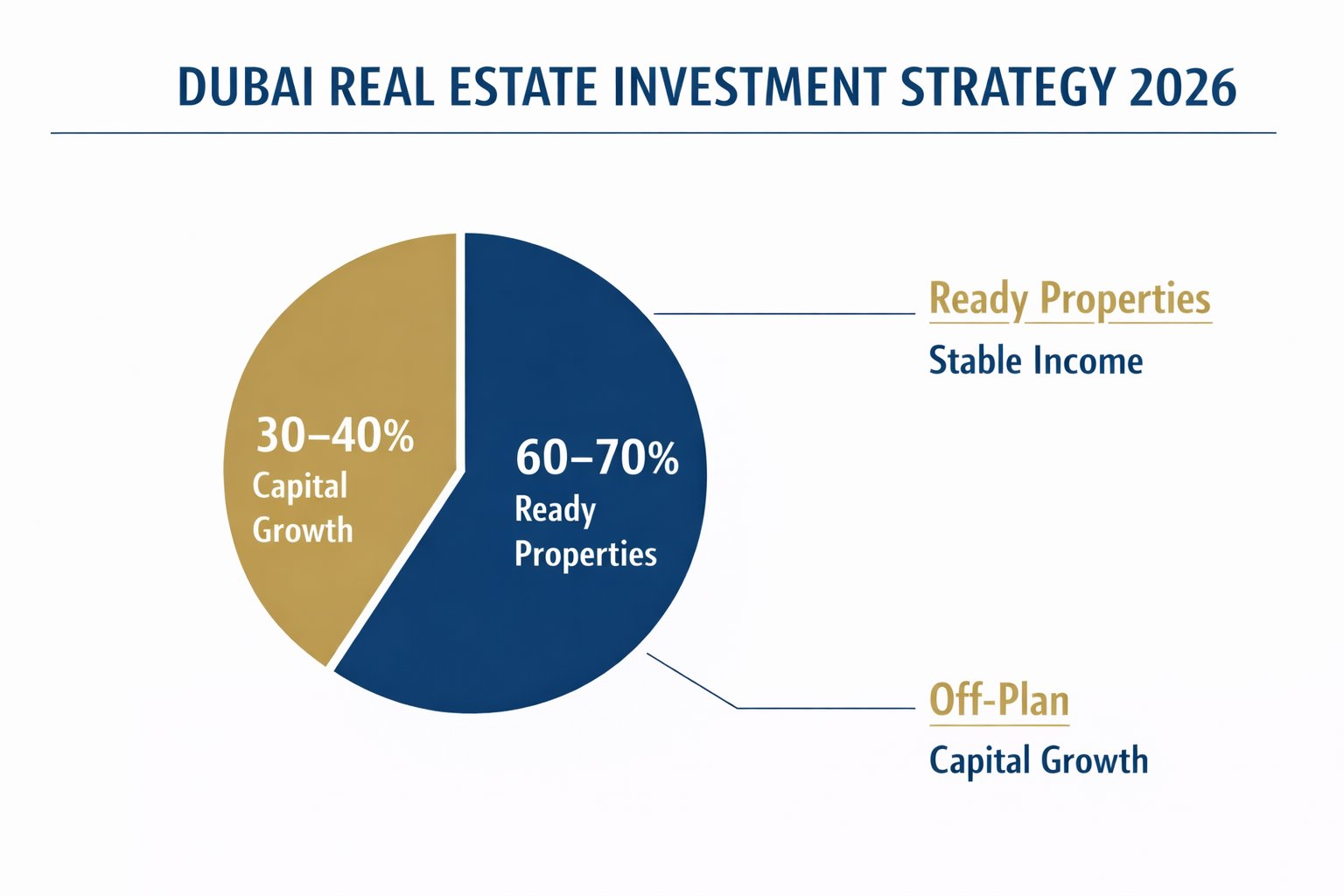
In simple terms, ready properties suit investors who value stability. The returns may not always be as dramatic as early-stage off-plan gains, but the structure is clearer. Income starts sooner. Risk feels more controlled.
For many international buyers, that trade-off is worth it.
ROI Comparison: Off-Plan vs Ready in 2026
Now, let’s look at this practically. Strip away the marketing language. What do the numbers actually suggest?
Capital Growth
If the goal is appreciation, off-plan often has the edge.
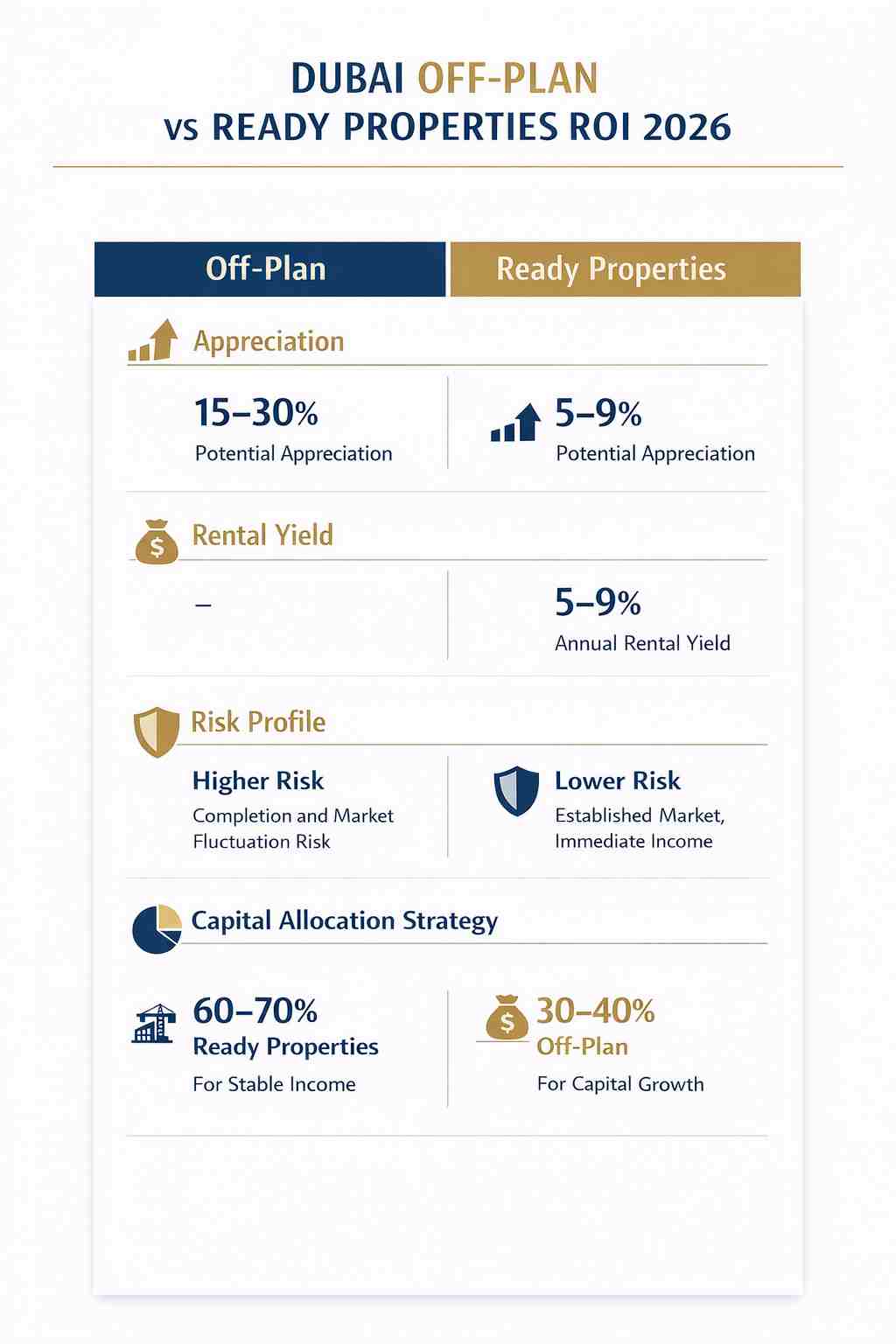
In recent years, well-priced launches have seen gains in the range of 15% to even 30% between initial release and completion. That upside does not happen automatically. It depends on location, timing, and the developer’s credibility. But the potential is there.
Ready properties behave differently. In prime areas, annual appreciation typically moves in the 5% to 10% range during healthy market cycles. It is steadier. Less dramatic. More predictable.
So, if you are chasing higher upside and are comfortable waiting, off-plan can offer stronger growth. If you prefer moderate and consistent price movement, ready stock feels safer.
Rental Income
This is where the difference becomes obvious.
An off-plan property produces nothing until it is handed over. No rent. No short-term income. You are waiting.
A ready property, on the other hand, can generate rental returns from the first month. In many Dubai communities, gross yields range between 5% and 9%, depending on the building and tenant demand.
For investors who rely on income or want their assets to support mortgage payments, ready units make more sense.
Risk Exposure
Every investment carries risk. The type of risk, however, is different.
With off-plan, you are exposed to construction timelines and market conditions at completion. If supply increases sharply or demand slows, resale margins can shrink. Delays, while not constant, are still possible.
With ready property, the building exists. The uncertainty is mainly tied to broader market cycles, rental shifts, resale demand, and interest rates. There is no construction variable involved.
Naturally, many conservative investors lean toward ready assets for this reason alone.
Capital Commitment
This part is often overlooked.
Off-plan purchases are structured around staged payments. You commit gradually. That lowers the initial financial pressure and allows you to spread your capital over time.
Ready property usually requires either full payment upfront or mortgage financing with a sizable down payment. Liquidity needs are higher from the beginning.
For investors managing multiple markets, off-plan can feel more capital-efficient. For those prioritizing simplicity, ready property may feel cleaner and more direct.