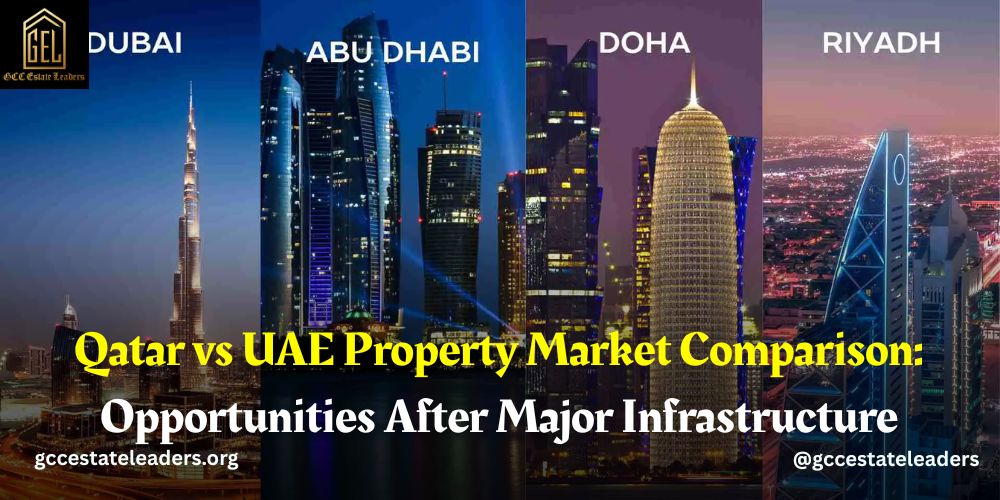
Major infrastructure investment has become one of the most powerful drivers of real estate value across the GCC. Few markets illustrate this better than Qatar and the United Arab Emirates, both of which have invested heavily in transport networks, urban regeneration, and smart-city development over the past decade.
As infrastructure projects move from construction to operational impact, investors are reassessing where the strongest post-infrastructure property opportunities now exist. This article compares the Qatar and UAE property markets, focusing on how recent and ongoing infrastructure development is shaping demand, pricing, and long-term investment potential.
Infrastructure as a Catalyst for Property Markets
Infrastructure does more than improve connectivity – it reshapes cities, shifts demand patterns, and unlocks new real estate corridors.
Across the GCC, large-scale infrastructure has supported:
-
New residential districts
-
Commercial hubs and logistics zones
-
Tourism and hospitality growth
-
Improved investor confidence
Both Qatar and the UAE now sit at different points in this infrastructure-driven cycle, creating distinct investment profiles.
For a broader regional context on current market strength, see:
👉 GCC Real Estate Outlook 2025: Market Strong Despite Global Uncertainty
Qatar Property Market: Post-Event Stabilization and Long-Term Planning
Infrastructure Legacy and Market Reset
Qatar’s recent infrastructure push has been defined by large-scale national projects, including metro networks, expressways, airports, and urban redevelopment zones.
With much of this infrastructure now operational, the property market has entered a post-delivery phase, where focus shifts from construction-led demand to utilization and occupancy-driven performance.
This transition creates opportunities for investors who prioritize:
-
Stability over speculation
-
Long-term rental demand
-
Government-backed urban planning
Residential and Commercial Demand
Residential demand in Qatar remains supported by:
-
High-income expatriate professionals
-
Government and corporate housing needs
-
Well-planned urban districts
Commercial real estate benefits from improved accessibility and centralized business districts, though growth tends to be measured rather than rapid.
Qatar’s market appeals most to investors seeking predictable performance with lower volatility.
UAE Property Market: Continuous Infrastructure-Led Evolution
A Rolling Development Model
Unlike Qatar’s event-driven infrastructure cycle, the UAE operates on a continuous development model. Infrastructure investment is ongoing and closely aligned with economic diversification strategies.
Cities like Dubai and Abu Dhabi continue to expand transport networks, smart-city systems, and mixed-use districts that directly influence property demand.
This constant evolution supports:
-
Strong transaction volumes
-
Diverse buyer profiles
-
High liquidity across asset classes
Residential, Commercial, and Mixed-Use Growth
The UAE’s property market benefits from:
-
Lifestyle-driven residential demand
-
Strong short- and long-term rental markets
-
Commercial growth linked to global business activity
-
Tourism and hospitality-led real estate segments
This diversity allows investors to tailor strategies based on yield, appreciation, or portfolio balance.
Technology and Smart Infrastructure Advantage
Technology integration is increasingly tied to infrastructure quality – and this is where the UAE currently holds an edge.
Smart-city frameworks, digital land registries, and PropTech adoption have improved transaction efficiency, transparency, and asset management.
For insight into how technology is reshaping property performance across the region, read:
👉 Top PropTech Trends Transforming Real Estate in the GCC
Qatar is also investing in smart infrastructure, but adoption tends to be more centralized and gradual compared to the UAE’s market-driven pace.
Regulatory Environment and Investor Access
Regulation plays a key role in determining how infrastructure benefits translate into real estate returns.
The UAE offers:
-
Well-established freehold ownership zones
-
Long-standing foreign investor participation
-
Clear resale and rental frameworks
Qatar allows foreign ownership in designated zones, providing access while maintaining tighter market controls.
For perspective on how evolving ownership rules across the GCC influence investor strategies, see:
👉 Saudi Arabia Foreign Real Estate Ownership in the GCC
While the link focuses on Saudi Arabia, it highlights a broader regional trend toward structured foreign investor access – relevant to both Qatar and the UAE.
Capital Movement and Cross-Border Strategy
Infrastructure maturity is influencing how investors allocate capital across GCC markets.
Increasingly, investors are:
-
Holding UAE assets for income and liquidity
-
Exploring Qatar for defensive, long-term positioning
-
Diversifying portfolios across multiple GCC countries
This behavior reflects a more sophisticated, region-wide investment mindset.
For a deeper look at this shift, read:
👉 How GCC Investors Are Looking Beyond Borders for Real Estate
Qatar vs UAE: Post-Infrastructure Comparison
| Factor | Qatar | UAE |
|---|---|---|
| Infrastructure phase | Post-completion | Continuous expansion |
| Market volatility | Low | Moderate |
| Liquidity | Moderate | High |
| Rental yield profile | Stable | Competitive |
| Foreign investor access | Controlled zones | Broad freehold access |
| Best suited for | Defensive investors | Yield & growth investors |
Where Are the Best Opportunities Now?
Qatar Opportunities
-
Well-connected residential districts
-
Long-term rental housing for professionals
-
Assets aligned with government planning zones
-
Lower volatility investment strategies
Qatar suits investors focused on capital preservation and steady returns.
UAE Opportunities
-
Transit-oriented developments
-
Lifestyle and mixed-use communities
-
Short-term and long-term rental assets
-
Commercial properties tied to global business growth
The UAE suits investors prioritizing liquidity, income, and scalable growth.
Where Are the Best Opportunities Now?
Qatar Opportunities
-
Well-connected residential districts
-
Long-term rental housing for professionals
-
Assets aligned with government planning zones
-
Lower volatility investment strategies
Qatar suits investors focused on capital preservation and steady returns.
UAE Opportunities
-
Transit-oriented developments
-
Lifestyle and mixed-use communities
-
Short-term and long-term rental assets
-
Commercial properties tied to global business growth
The UAE suits investors prioritizing liquidity, income, and scalable growth.
Final Thoughts
Infrastructure investment has fundamentally reshaped both Qatar and UAE property markets, but in distinct ways.
Qatar’s opportunity lies in post-delivery stability and long-term planning.
The UAE’s strength lies in continuous evolution, liquidity, and global connectivity.
For investors willing to look beyond short-term cycles, both markets offer meaningful opportunities – especially when approached as part of a diversified GCC real estate strategy rather than isolated bets.